Listen to this full article while you work or play. Try it out. 

Rbhu Engineering
6:35
lodestar_06

Getting Started

When Rbhu launched, the entire “team” was Alireza and Selinda sharing a single RISA‑3D dongle between them. Alireza came from a background in mechanical and offshore structural engineering, using tools like SAP2000 for complex analyses, while Selinda brought structural engineering experience and had already used RISA extensively. RISA’s combination of reasonable cost at the time and approachable workflow—materials, sections, loads, then analysis—made it the practical choice for a young firm taking on highly atypical structures.

Compared to other software, RISA‑3D felt more intuitive to Alireza: the step‑by‑step setup and clear code‑check reporting allowed the team to quickly understand how the software was treating each member. As the company grew beyond two people, they moved from the original dongle model into multiple subscriptions and added RISAFoundation to streamline the handoff from global analysis to foundation design.

Building Sculptural Structures, Not Just “Projects”

Rbhu Engineering is a structural engineering firm dedicated almost exclusively to large‑scale artworks and sculptural architectural pieces, from Burning Man installations to permanent public art and intricate treehouse experiences. Co‑founders Alireza and Selinda started the company in 2014 after a series of collaborations with artists like Marco Cochrane and Peter Hudson, where they were asked to turn ambitious kinetic and sculptural ideas into safe, buildable structures. Today, roughly 80–90% of their work is art‑driven, with the remaining 10–20% in highly customized residential and non‑traditional structures they still consider “art” rather than typical buildings.

From the beginning, Rbhu has focused on projects where the structure is the sculpture. That means their engineering decisions are always constrained by aesthetics, fabrication realities, and cost—often in that order. Instead of hiding structural systems behind cladding, they work inside the artist’s form, finding load paths and support strategies that remain visually honest to the original concept.

“We fell in love with RISA because it let us use one tool to design complex, sculptural structures in a way that was still fast and practical for a small team.”

Alireza Lahijanian
Principal at Rbhu

rbhu_engineering_imagination_logo

Advancements with RISA

Rbhu’s projects rarely resemble traditional buildings. Their structures can start as napkin sketches, hand‑drawn concepts, or highly detailed Rhino models from artists and architects. For simpler geometries, the team may model directly in RISA‑3D; for complex shells and curved forms, they rely on Rhino models that are cleaned and converted into “centerline” or shell models suitable for import into RISA. This centerline‑model approach is essential in their workflow, and Rbhu has even created internal documentation to help clients prepare models that will behave correctly in analysis.

On projects like the Shhh Pavilion—a canopy structure in San Diego composed of steel and aluminum plate elements—Rbhu used RISA‑3D as their primary global analysis tool. The plates were imported from Rhino, meshed and processed in RISA-3D, and then the results were validated with heavier finite element software. RISA-3D’s strength in this workflow is speed and responsiveness: it allows Rbhu to iterate quickly, understand global behavior, and refine the design before moving into more computationally expensive checks.

Projects with RISA

Ad Astra (1)
Empyrean (4)
Lodestar (1)

Get Started with RISA

Overcoming Challenges: “The Dance” Between Vision and Reality

Every Rbhu project is a negotiation between structural necessity and artistic intent. Early in a job, the team’s first questions are conceptual: Will the design be controlled by seismic loads, wind loads, or something else entirely? They chase the expected load path, then use RISA-3D to test that intuition, often discovering alternative behaviors or critical regions they didn’t initially anticipate. Looking at basic load cases, deflected shapes, reactions, and modal behavior in RISA-3D is a standard part of their process to verify that the model is behaving the way they believe it should.

Iteration happens on two fronts:

  • Internal structural iteration, where Rbhu adjusts thicknesses, member sizes, and support strategies in RISA-3D to resolve strength, stiffness, and detailing requirements.

  • Client‑facing iteration, where they present multiple structural options in virtual working sessions—showing how each approach affects aesthetics, cost, and buildability—before locking in a “structural vision” that aligns with the artist’s concept.

Because many structural components are fully exposed, Rbhu cannot simply add hidden bracing or visible supports that conflict with the artwork. Instead, they propose organic, visually cohesive solutions—like subtly integrated supports or internal stiffening strategies—often offering several RISA‑based schemes for the artist and fabricator to evaluate. Throughout design and into construction administration, RISA models are revised to accommodate fabrication realities, as‑built variances, or late‑stage constraints such as clashes with cladding or weight limits on existing structures.


Looking Ahead: Lessons Learned

Over years of sculptural work in RISA-3D, Rbhu has developed a disciplined approach to modeling and QA/QC that they consider essential. Key practices include frequent use of model merge to remove duplicate elements, careful control of member orientation and releases, and routine checks of deflected shapes and reactions under basic load cases before relying on full load combinations. They also maintain an internal QA checklist and perform targeted hand calculations to verify their RISA-3D results are reasonable, particularly where code checks or slenderness warnings may be overly conservative for their specific conditions.

Rbhu is clear that structural software cannot be treated as a black box. For them, working in RISA-3D is “a dance” between engineering judgment and numerical output: engineers must understand why members fail, what each code check represents, and where to refine the model or the design itself. As they continue to grow, the team plans to deepen their use of RISA’s advanced features—such as custom sections and enhanced reporting—while advocating for tools and educational content (like centerline‑modeling guides) that better serve artists, architects, and engineers working at the intersection of art and structure.


Quick-Clips

Listen to quick sound-bites from our interview with Rbhu.

More Intuitive Software
0:20
Powerful Technical Support
0:46
Working with an Artist
2:32

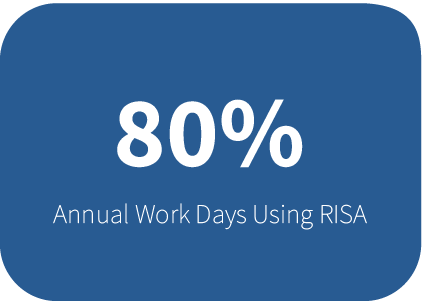
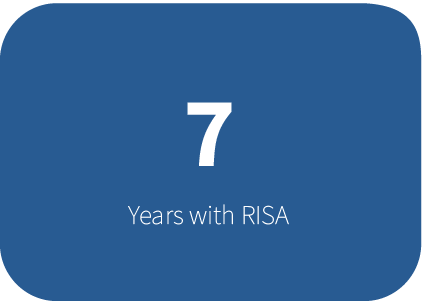
Rbhu Engineering By the Numbers

mdep_products-01

mdep_work days-01

mdep_years-01

Rapid Fire Questions

Want to see how RISA could support your projects?
Ask our Sales Team

What types of projects do you use RISA for?
Rubu uses RISA primarily for large‑scale artworks and sculptural architectural pieces, including Burning Man installations, public art, and architecturally expressive structures where the structure is the sculpture. They also apply RISA to highly customized residential and non‑traditional projects that behave more like art than conventional buildings.
Which RISA products do you use most?
RBHU relies on RISA‑3D for fast global analysis of complex geometries, RISAFoundation to seamlessly extend those models into foundation design, and RISAConnection for steel connection design where applicable. Together, these tools help them move from artist concept to buildable, code‑compliant solutions without breaking their workflow.
How does RISA support your focus on engineering judgment?
RISA allows RBHU to quickly explore different load paths, check deflected shapes, and iterate structural options while staying true to the artist’s vision. Detailed code‑check reporting and transparent equations support their emphasis on engineering judgment—ensuring they never treat the software as a black box and can confidently balance aesthetics, safety, and constructability.